Community Engagement Platform
A single content, identity, and distribution core that powers a membership community across owned web surfaces and earned social reach.
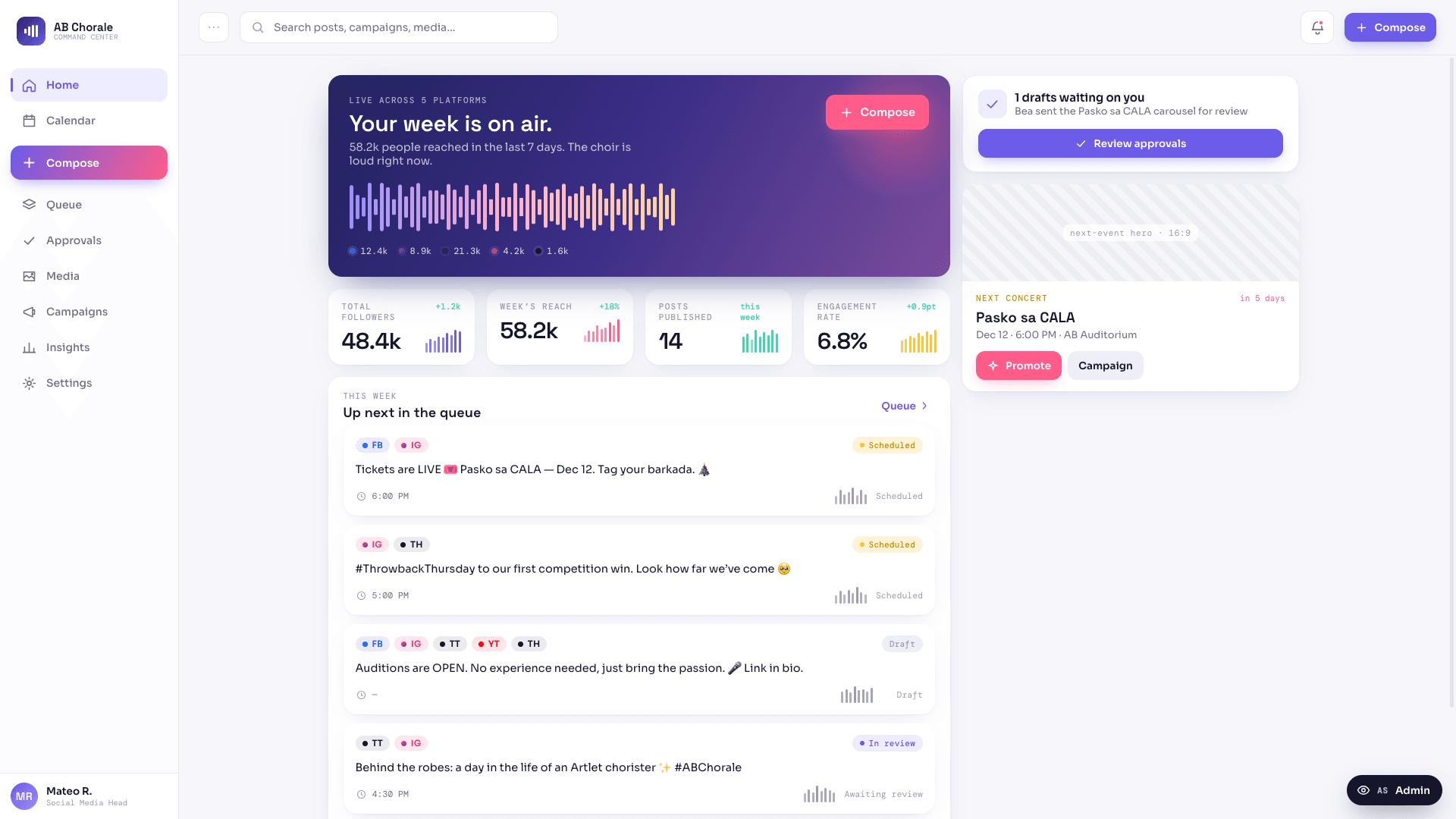
UST CALA Community Engagement Platform — Engine
A single content, identity, and distribution core that powers a membership community across owned web surfaces (portal + CMS + back office) and earned social reach (organic publishing + word-of-mouth). Purpose-built for a performing-arts membership community — current members, alumni, and fans — and described here at the engine level rather than as a specific site.
Community segments
Current Members — the active performers; primary content creators and word-of-mouth amplifiers.
Alumni — the donor and buyer base; reached through owned channels with direct asks.
Fans / Followers / Friends / Families — the reach audience; served by public surfaces and organic social.
Design principles
Module-engine — locked layout layer + structured authoring; admins fill content, never touch design.
Relational-first — concerts, rosters, setlists, and repertoire are a relational domain, not document soup.
Single identity layer — one canonical user key across every surface and channel.
Privacy by design — per-field consent governs every exposure (RA 10173-aware).
Mobile-adaptive as a first-class concern — native app patterns, not a shrunk desktop.
Part 1 — Community Core
Identity, Membership & Access
The people layer: defines who belongs, what they can see, and what they can do.
Segmented Membership Model
(Core v1.0)— three first-class segments with distinct lifecycles; members graduate into alumni, fans are lightweight follows.Role-Based Access Control
(Core v1.0)— superadmin plus functional roles (branding, tech, marketing, admin) on a least-privilege model.Identity Layer
(Core v1.0)— a single provider-agnostic auth layer; one user key shared across portal, back office, and channels.Consent & Privacy Controls
(Core v1.0)— per-field directory visibility, with promotional/marketing consent as a separate toggle from directory visibility.Member Directory
(Module v1.0)— searchable and consent-filtered, with fuzzy and full-text matching.Profile & Lifecycle
(Module v1.0)— onboarding, member→alumni transition, and status management.
Part 2 — Content Engine
Authoring, Experience & Surfaces
The module-engine: admins author content once into structured modules; a locked layout renders it consistently across every surface.
Locked Layout System
(Core v1.0)— the visual/layout layer is fixed; authors fill structured fields, protecting brand integrity through rotating volunteer staff.Module-Based CMS
(Core v1.0)— content types (pages, news, events, concerts) as reusable modules; author once, render anywhere.Public Surfaces
(Core v1.0)— the audience-facing web experience and the canonical home every campaign points back to.Member / Alumni Back Office
(Module v1.0)— gated self-service surfaces for signed-in members and alumni.Admin Console
(Core v1.0)— unified content, user, and configuration management.Mobile-Adaptive Delivery
(Core v1.0)— bottom tab bar, bottom sheets, FAB, and swipe gestures as first-class behavior.Media & Asset Pipeline
(Module v1.0)— object-storage-backed media with responsive delivery.Relational Content Domain
(Suggested v1.0)— concerts, rosters, setlists, and repertoire modeled with junction tables.
Part 3 — Engagement Engine
Distribution, Campaigns & Word-of-Mouth
The outbound and activation layer: turns authored content into multichannel reach and pulls the community back to owned surfaces, with attribution closing the loop.
Social Command Center
(Module v1.0)— compose, schedule, and publish organic content to the five free platforms (Facebook, Instagram, TikTok, YouTube, Threads) with per-platform live previews.Concert Campaign Object
(Core v1.0)— the unifying campaign entity: author a concert once and it generates the landing page, social drafts, and shareable assets.Word-of-Mouth Assets
(Core v1.0)— pre-made cards and personal share links for members and alumni to forward through messaging platforms.Conversion Surfaces
(Module v1.0)— ticketing and donation calls-to-action on the canonical campaign page.Attribution & UTM
(Suggested v1.0)— every outbound link tagged so each channel's contribution to tickets and donations is visible.Inbound Monitoring & Engagement
(Candidate v1.1+)— unified comments, mentions, and DMs; the listening half of a true command center.Paid Ads Channel
(Candidate v1.1+)— deferred to the far future; slots in as a parallel channel against the same concert object when needed (Marketing API, budgets, approvals).