Crowd Evacuation Simulator
An agent-based crowd-evacuation engine built to stress-test building layouts before they're built.
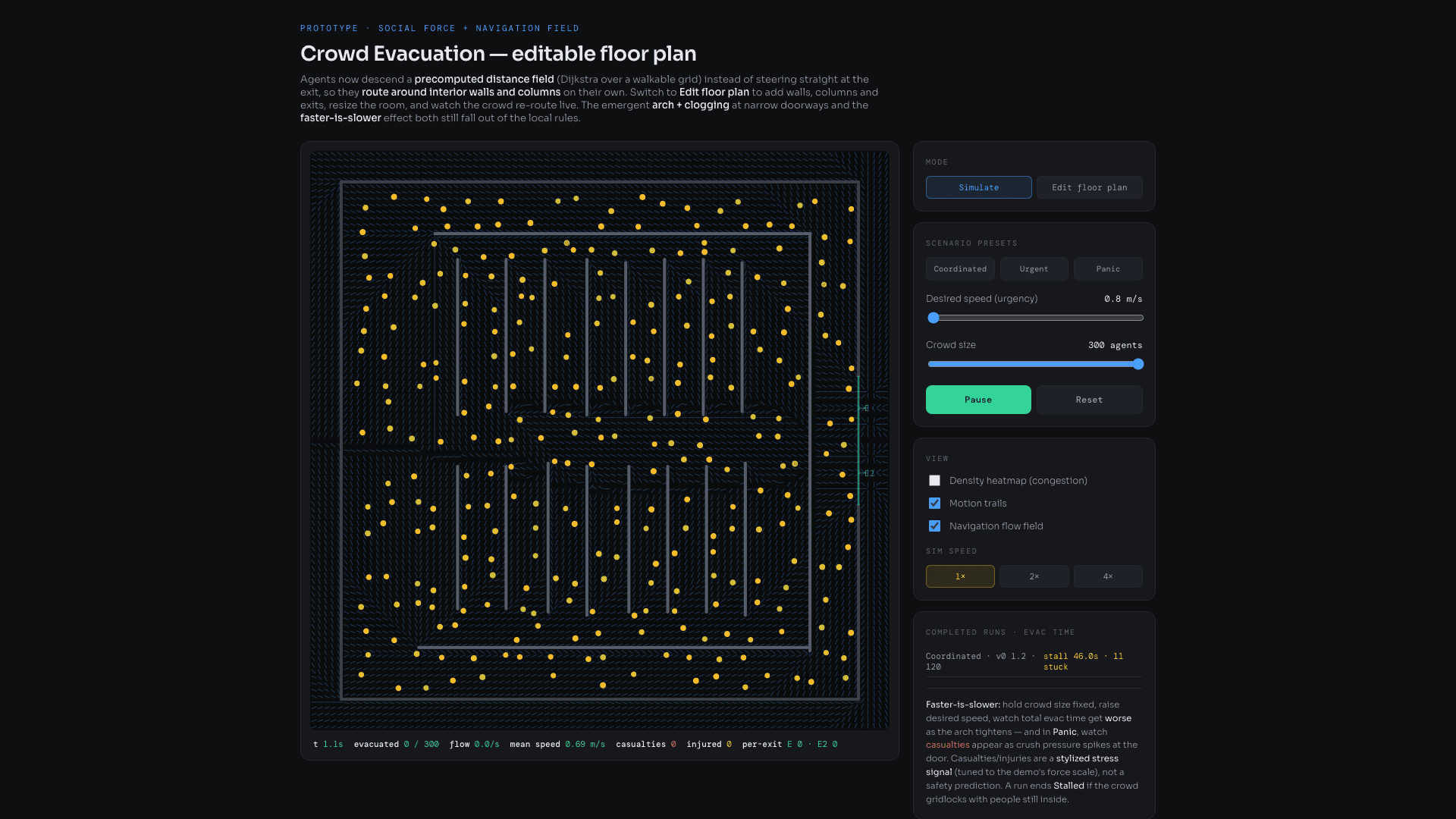
An agent-based crowd-evacuation engine built to stress-test building layouts before they're built. Every pedestrian is an autonomous point mass obeying only local rules — drive toward an exit, repel from neighbours and walls. Nobody choreographs the crowd, yet realistic failure modes emerge on their own: doorways clog, an arch jams the bottleneck, raising panic makes evacuation slower, and under sustained pressure a crowd-crush produces casualties that themselves narrow the exit. The engine's job is to surface where a design fails — fast, cheap, and at the early-design stage.
The core is the Social Force Model (Helbing–Molnár). Each agent is a 2D point mass; its acceleration is the sum of a goal-driving force and pairwise/wall interaction forces, integrated in SI units. Constants are tuned for a legible, stable demo rather than literature-exact calibration.
Agents need to know which way is out. The first prototype steered straight at the exit — fine for one convex room — but the engine now routes on a precomputed distance field per exit, so paths bend around walls and corners and can reroute when an exit is lost.
Under sustained compression a real crowd doesn't merely slow down — people are injured and killed. The engine models this with a Helbing-style crush-dose: agents accumulate damage from prolonged contact force, degrade through injured to dead, and once dead become obstacles that make the jam worse.
Crowd sims live or die on the neighbour query and on numerical stability at high density. The engine stays linear with spatial hashing, avoids t=0 force explosions with a deterministic spawn, and proves behaviour with a headless test harness before any feature is called done.
Every scenario is the same engine with different constants and a timeline of events — never new engine code. Today it ships speed-layer presets; the richer hazard scenarios are designed as parameter layers plus an event system that triggers them mid-run.