GeoWatch
A geospatial multi-intelligence platform that fuses GEOINT, SIGINT, OSINT, and related sources into a single situational-awareness command interface.
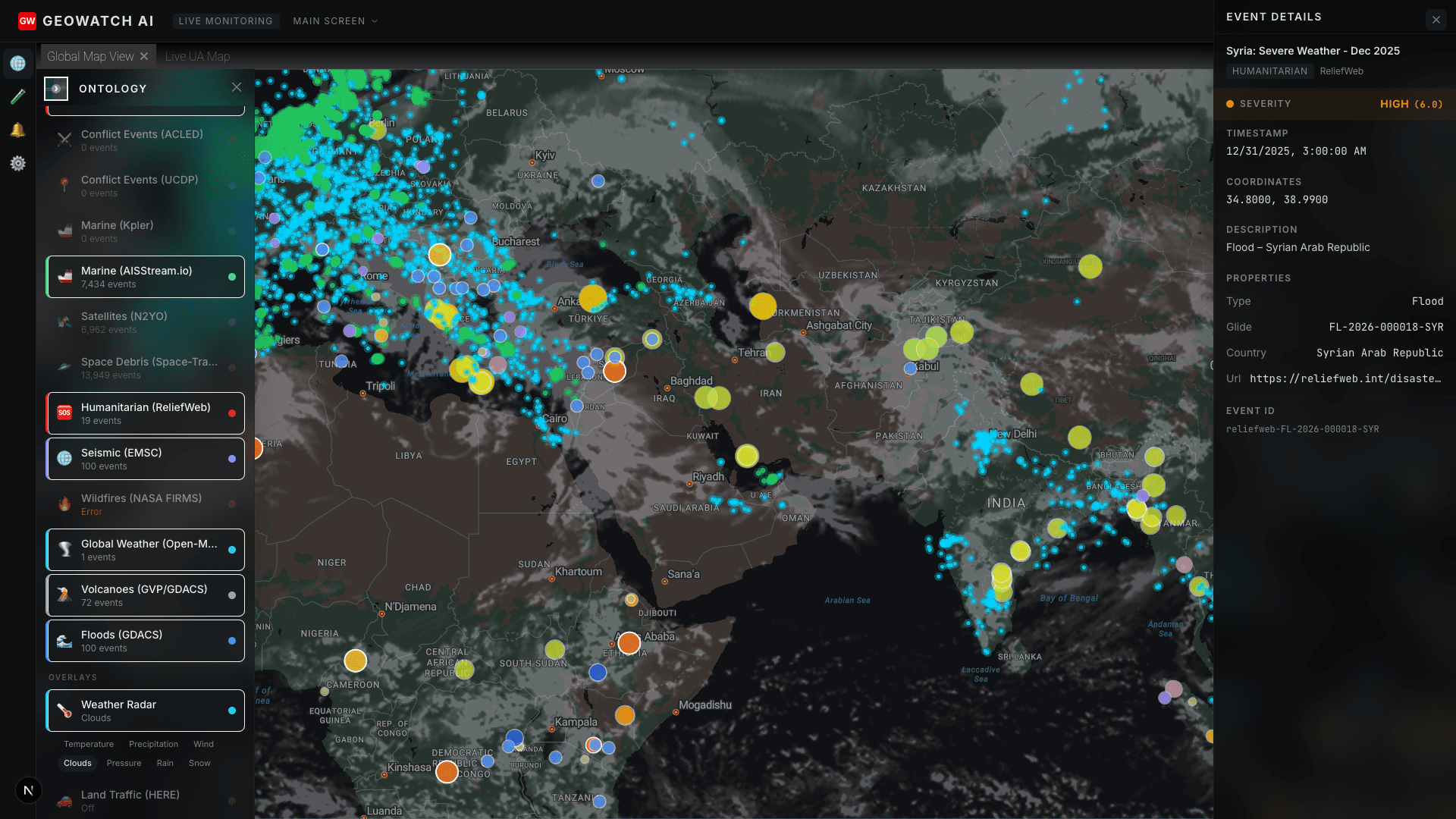
GeoWatch AI is a planetary multi-intelligence platform that solves the "intelligence convergence" problem — the reality that modern intelligence fails not from a lack of data but from a lack of synthesis. It ingests billions of data points across 40+ global sources spanning geophysical (USGS seismic, volcanic, space weather), maritime (AIS vessel tracking via AISStream.io and Kpler), aviation (ADS-B), conflict (ACLED, UCDP, GDELT), social chatter (BlueSky, Reddit, Telegram, dark web crawlers), and supply chain (OpenSanctions, customs records) domains. These feeds are fused into a continuously updated digital twin of global stability, surfaced through a Bloomberg Terminal–style command interface where analysts assemble dense situational-awareness dashboards from a library of 30+ specialized widgets, anchored by a CesiumJS 3D globe rendering photorealistic terrain and live telemetry layers.
The analytical core is built on three engines. A weighted threat-scoring system produces composite global and regional risk scores from geophysical, vulnerability, and societal-instability factors, updated on a continuous cadence and delivered live to the dashboard. A physics-based planetary simulator models high-impact scenarios — asteroid impacts, nuclear detonations, cascading infrastructure failures — using published scientific models (Collins et al. impact physics) to produce quantified projections of blast radii, casualties, and second-order effects like agricultural collapse and climate aftermath. Sitting above both is a multi-agent "swarm intelligence" engine (MiroFish/LangGraph) where AI agents with distinct adversarial and analytical personas debate intelligence questions, spontaneously challenge consensus, and are stress-tested by a dedicated red-team agent (MAESTRO) before any conclusion is finalized — with every assertion bound to a tamper-evident SHA3-256 provenance chain for evidentiary integrity.
Architecturally, GeoWatch is a polyglot microservice system that routes each workload to the language best suited for it: TypeScript/Next.js and NestJS for the frontend and API gateway, Elixir/Phoenix for sub-millisecond real-time streaming, Rust for high-speed consensus math, and Python for the agent swarm and geospatial/ML pipelines, all coordinated over Kafka with PostgreSQL/PostGIS, Neo4j, Qdrant, and Redis underneath. It enforces multi-level security throughout via the Bell-LaPadula model and ships with a Tauri-based desktop companion for disconnected, air-gapped, and field operations. Strategically, GeoWatch is positioned as a domain-specific vertical application — a Foundry-shaped product rather than a direct Palantir competitor — differentiated by its 41-source fusion catalog, swarm reasoning layer, and physics engine, targeting civilian critical infrastructure, quasi-defense civilian, and direct defense contracts across its priority markets.